


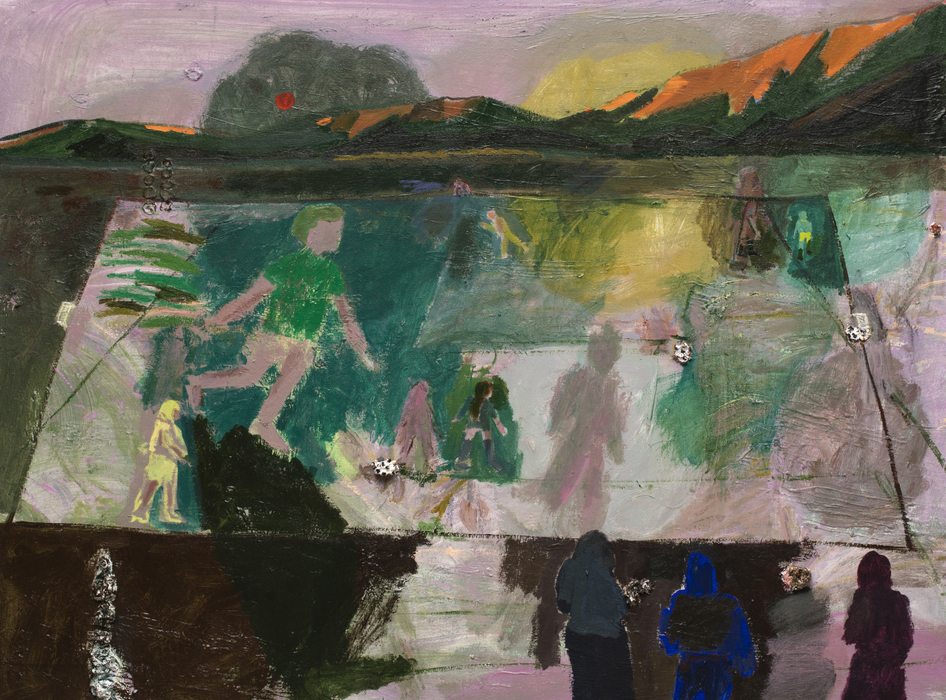
Lisa Sanditz


Lisa Sanditz, 2026
Lisa Sanditz: Missing Mountain
ALEXANDRE 25 East 73rd Street, 3rd floor, New York, NY 10021
September 18 – November 7, 2026
Fully illustrated catalogue with text by Barry Schwabsky will be available.
ALEXANDRE is pleased to present Missing Mountain, an exhibition of new paintings and works on paper by Lisa Sanditz, on view from September 18 – November 7. This is the artist’s first solo exhibition in New York in over a decade. Sanditz has spent more than two decades making landscape painting with a palette that runs hot and synthetic, closer to Kool-Aid, while maintaining an active dialogue with the paintings of the Hudson River School. Working from drawings, photographs, and notations gathered on site, Sanditz paints compositions where scale, gravity, and distance refuse to settle: a horizon tips, a figure turns sideways, a single flower looms larger than the hills behind it. She lives and works in the Hudson Valley, where much of the material for this exhibition was gathered, and the region’s terrain has long been less a backdrop to her practice than its subject and its source.
Many of the paintings in Missing Mountain take their subject from a single vanished view: the Catskill Mountains, erased from the horizon by wildfire smoke. In the summer of 2023, heading north through the Hudson Valley on a clear, bright day, Sanditz looked west toward the Catskills and found that the mountains were not there. There are ordinary reasons a view disappears—snow, fog, rain, nightfall—but this was none of them. Smoke from the Canadian wildfires had followed the trade winds into the East Coast skies for the first time, and the air was dense enough with particulates to erase a mountain range. The temporary disappearance of such a monolithic geological feature was destabilizing.
At the center of the exhibition is a group of landscape paintings that return to the same view under different conditions of visibility. Shifting color, pattern, and saturation to partially obscure the scene, Sanditz draws each painting’s palette and mood from a specific way of seeing, whether that be pollutant haze, dazzling night skies, summer heat, an eclipsed sun, or snow.
Other works in the exhibition explore the missing, the ephemeral, and the unexpected by different routes. Big Foot (2026) sets a colossal teenage foot at the ocean’s edge; Debris Flow (2026) considers the tangled relationship between forest fires, mudslides, and California dreaming, and Wild Violets (2026) follows a raucous group of women hunting for wild violets during the flowers’ brief spring appearance.
The exhibition is accompanied by an essay by the critic Barry Schwabsky, who describes Sanditz’s method as one of “hyperaccumulation,” in which colors, marks, stories, and places are improvised into a single, slightly off-kilter view. As he writes, “It’s a challenge and that’s why it’s exhilarating.”
Mud Minors, 2026, acrylic on canvas, 20 x 16 inches
Missing Mountain (Hot Pink), 2026, acrylic on canvas, 30 x 40 inches
Missing Mountain (Storm), 2026, acrylic on canvas, 30 x 40 inches
Missing Mountain (Stewart's Sherbet Sun), 2026, acrylic on canvas, 30 x 40 inches
Debris Flow, 2026, acrylic on canvas, 42 x 54 inches
Spring Ephemeral (Lily), 2026, acrylic on canvas, 42 x 54 inches
Wild Violets, 2026, acrylic on canvas, 42 x 54 inches
Ghost Tree (Dark), 2026, acrylic on canvas, 42 x 54 inches
Big Foot, 2026, acrylic on canvas, 36 x 48 inches
The Green Woman (and The Green Man/Forsythia), 2026, acrylic on canvas, 36 x 48 inches
Wood Lilies, 2025, ink and watercolor on paper, 19 x 15 inches
Swamp Rose Mallow, 2025, colored pencil on paper, 19 x 15 inches
Green Headed Coneflower, 2025, colored pencil, ink and watercolor on warm Stonehenge paper, 19 x 15 inches
Blue Flag Iris (Night), 2025, colored pencil, ink and watercolor on paper, 19 x 15 inches
Blue Flag Iris & Wood Lily, 2026, watercolor on paper, 19 x 15 inches
Dutchman's Britches, 2026, colored pencil and watercolor on paper, 15 x 11 inches
Wild Violets, 2026, colored pencil and watercolor on paper, 19 x 15 inches
Jack-in-the-Pulpit, 2026, watercolor on paper, 11 x 15 inches
Promethea Moth (Female), 2026, colored pencil on paper, 9 x 12 inches
Promethea Moth (Male), 2026, colored pencil on paper, 9 x 12 inches
Color Study 13, 2025-26, watercolor on paper, 9 x 12 inches
Color Study 12, 2025-26, watercolor on paper, 9 x 12 inches
Color Study 4, 2025-26, watercolor on paper, 9 x 12 inches
Color Study 2, 2025-26, watercolor on paper, 9 x 12 inches
Color Study 5, 2025-26, watercolor on paper, 12 x 9 inches
Color Study 7, 2025-26, watercolor on paper, 12 x 9 inches
Color Study 9, 2025-26, watercolor on paper, 12 x 9 inches
Color Study 3, 2025-26 watercolor on paper, 12 x 9 inches
